137★ for 7 months, then 257,319★ in 8 more: Hermes Agent and OpenClaw — both made it, with the money flowing in opposite directions
Evidence date: 2026-10-27 (UTC+8)
Scorecard re-check (5 dimensions × 20, scored after evidence collection): reachability 20 · verifiability 19 · uniqueness 16 · audience relevance 17 · multi-dimensional space 17 = 89/100 (we only write above 60; backlog pre-score 88). Framework card = comparative head-to-head (piece #18 was a business model canvas, so the rotation rule is satisfied; the last head-to-head was piece #13): this piece is not a feature review and not a vulnerability list — it walks how two success paths were each achieved → the axes of difference → the price of those differences, with risk and governance issues kept as a side-line of path difference, never written as a failure-avoidance piece. One-line thesis: same track, same breakout curve — one path keeps the money on the company's books, the other keeps it outside the foundation's door. Both made it, and the price looks nothing alike.
1. The head-to-head table: eight cells, both sides sourced
| Cell | Hermes Agent (evidence 2026-10-27) | OpenClaw (evidence 2026-10-26, reused from #18) |
|---|---|---|
| Stars, double reading | API 257,319 / page 257,321 (Sources 1/2) | API 393,064 / page 393,064 (Sources 45/47) |
| Breakout curve | repo created 2025-07-22 → only 137★ on 2026-02-25 → 250,484★ on 10-01 (Wayback ×6) (Sources 3/4/5/6/7/8/11) | repo created 2025-11-24 → +237,633★ in 9 weeks → 393,064★ in 11 months (Sources 47/49/50) |
| Commits / contributors / concentration | 59,466 commits · 401 contributors / 51,995 contributions · top1 teknium1 24,806 = 47.7% (Sources 1/30/31) | 119,646 commits · 383 contributors / 113,798 contributions · top1 steipete 67,083 = 58.9% (Sources 46/51/52) |
| Issue / PR closure rate (same search basis) | issues 17,234 open / 20,031 closed → 53.7%; PRs 68.3% (Sources 26/27/28/29) | issues 5,056 open / 56,178 closed → 91.7%; PRs 2,768* open / 117,531 closed → 97.7% (Sources 48/53/54/55) |
| Channel count | site 7 (Telegram/Discord/Slack/WhatsApp/Signal/Email/CLI), README feature table 6 (Sources 12/14) | README "and 20+ more" + site 29 channels (Sources 45/46) |
| Funding model | Company (Nous Research, Inc.): $90M Series B @$1.5B (2026-10-07), $158M total; the agent is MIT-free, revenue comes from Portal subscriptions $0/$20/$100/$200 (Sources 38/12) | 501(c)(3) foundation (2026-07-08); site states in three places no subscription, no hosting, no token — zero revenue (Sources 45/56/57) |
| Risk events | HN 1,251-point billing event; #10232 comment deletion and title rewrite; Parallel default routing reverted in 10 minutes; CVE ×2 (CVSS 3.1 = 7.3) (Sources 22/23/25/34/35) | CVE-2026-33579 privilege escalation 9.4; Anthropic subscription ban HN 1,099, name-based refusal HN 1,349; "security nightmare" 397 points (Sources 58/59/60/61) |
| HN volume structure | top scores are almost all events (1,251 billing / 122 migration); the product post scored only 52 and linked to a .org that now returns 451 (Sources 17/18/19) | product and confrontation threads score high on their own (1,349 / 1,099 / 802 / 667) (Sources 59/60) |
[Fact] None of the eight cells is a verdict on "who is better"; all eight are reproducible readings. Where the two sides differ in basis (issue closure rate, channel count, concentration), the arithmetic has been unified — the working is shown in section 7.[Fact]
2. Path A: Hermes' seven months of sleep, and the eight months after
The repository was created at 2025-07-22T22:22:28Z; the earliest commits land on 2025-07-26 (hjc-puro twice, Teknium merging PR #1), then a first-pass content scraper on 07-31 — that is the entire public record of the start. (Sources 2/11)[Fact]
Then came 7 months of silence. The first usable Wayback snapshot of the repo page is 2026-02-25, reading 137★; the same archive window shows traces of 370 commits, so the code kept moving while nobody watched. (Source 3)[Fact][Unverified] The CDX query for 2025-07 → 2026-02 returned an empty body this round, so there is no second ruler to confirm the star curve in that window — this article uses the single 02-25 point and never extrapolates it into "zero attention."
The turning point shows up as two nearly coincident readings: the official site hermes-agent.nousresearch.com was first captured by Wayback on 2026-03-05 (Source 9), the repo hit 2,297★ on 03-08 (Source 4) and 20,623★ on 04-01 (Source 5).
| Wayback snapshot | Stars | Interval gain | Per day | Source |
|---|---|---|---|---|
| 2026-02-25 | 137 | 218 days since creation | 0.6/day | 3 |
| 2026-03-08 | 2,297 | +2,160 / 11 days | 196/day | 4 |
| 2026-04-01 | 20,623 | +18,326 / 24 days | 764/day | 5 |
| 2026-06-01 | 174,961 | +154,338 / 61 days | 2,530/day | 6 |
| 2026-08-01 | 223,796 | +48,835 / 61 days | 800/day | 7 |
| 2026-10-01 | 250,484 | +26,688 / 61 days | 438/day | 8 |
| 2026-10-27 (API, measured) | 257,319 | +6,835 / 26 days | 263/day | 2 |
[Fact] Seven months after creation the repo had 137★; the following seven-plus months (to the 10-01 snapshot) absorbed 250,347★, and the API reading on evidence day was 257,319★ — with 04-01 → 06-01 alone accounting for 154,000★ in 61 days, the steepest segment of the whole curve. Every number is read verbatim from the snapshot pages' aria-label="… users starred" attribute, not estimated. (Sources 3/4/5/6/7/8/2)[Fact]
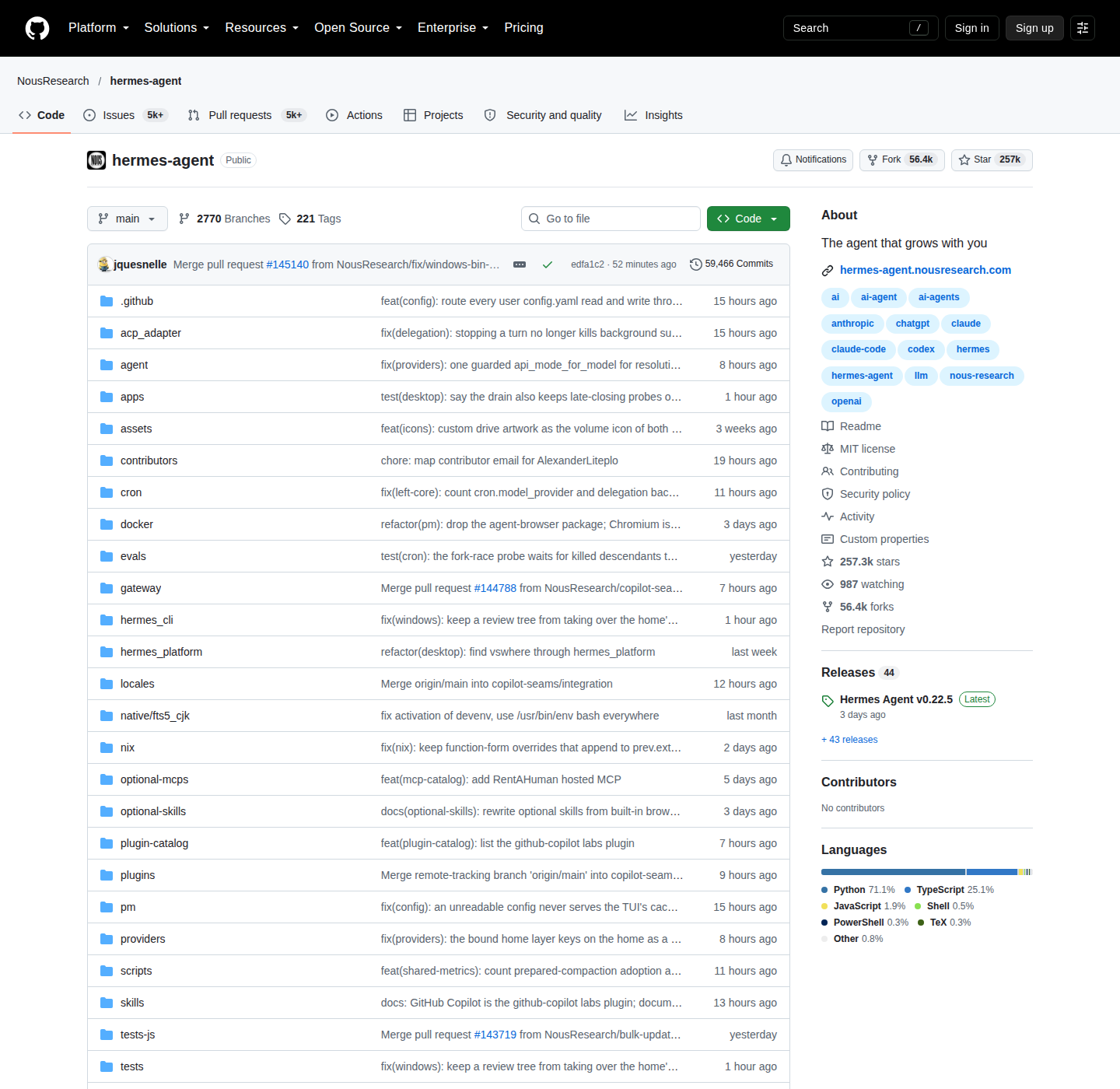
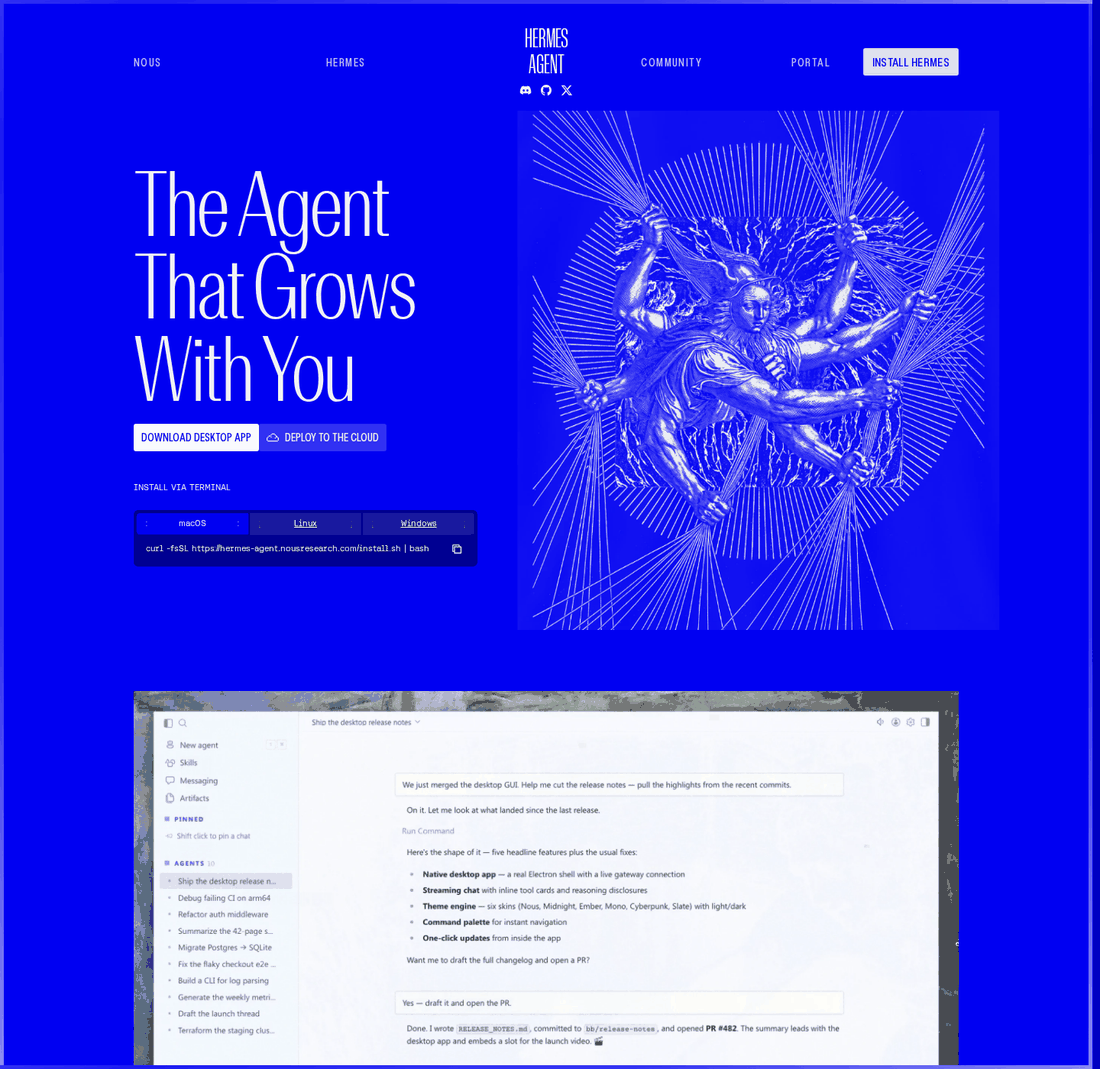
[Inference] Lay the site's first capture (03-05) next to three star readings — 2,297 on 03-08, 20,623 on 04-01, 174,961 on 06-01 — and the growth start is not the creation date, it is the day of productization: desktop app plus official site plus one-line installer translated "a research repository" into "something you can install," and seven months of committed code got cashed into attention over three months. (Sources 9/4/5/6/14)[Inference][Opinion] The dormant phase was not waste — without that density of commits, the launch day would have had no feature surface worth screenshotting.
3. Path B: OpenClaw's nine-week spike, and the plateau it has lived in for six months
The counterparty's curve has a different shape entirely. The readings from piece #18: repo created 2025-11-24, already 106,177★ on 2026-01-30, 343,810★ by 04-01 — +237,633★ in 61 days (9 weeks), about 3,896 stars a day; then only +47,347★ across the six months from 04-01 to 10-01, about 259 stars a day. (Sources 47/49/50)[Fact] The official account of the starting point is in the rename announcement: "Two months ago, I hacked together a weekend project… over 100,000 GitHub stars and drew 2 million visitors in a single week." (Source 56)[Fact — self-reported]
[Inference] Stacked on top of each other, the two curves differ not in "which rose faster" but in the ignition mechanism: OpenClaw's trigger was an internet-wide rename explanation (Clawd → Moltbot → OpenClaw, with the announcement itself written as a launch post), while Hermes' trigger was a productization launch (official site + desktop app + installer); one runs on event density, the other on delivery density. (Sources 56/9/12/14)[Inference]
What matters more is the converged speed. Hermes averaged 263★/day over the 26 days before evidence day (Sources 2/8), while OpenClaw's six-month plateau averaged 259★/day (Sources 49/50) — two projects with different origins and different rhythms both converge to "about 260 stars a day" of stock growth.[Fact]
[Opinion] This is probably the shared gravity of breakout open-source projects: spike height is set by events, plateau speed is set by how many people install it per day, and the latter hardly cares who the project is or how much money it raised. The shared lesson for both paths — never plan against any number from the spike window.
4. Difference axis one: the money runs in opposite directions — a $1.5B company versus a zero-revenue foundation
On the Hermes side the money line is a full corporate financing line. TechCrunch, 2026-10-07: $90M Series B at a $1.5B valuation, led by Robot Ventures, with Nvidia, Union Square Ventures, Menlo Ventures, Samsung and 1789 Capital participating, $158M raised in total, launched alongside Hermes for Businesses. (Source 38)[Fact] The product-side price list hangs on Nous Portal: Free $0 / Plus $20 / Super $100 / Ultra $200 per month, all tiers including monthly credits, 200+ models and built-in tool use; the agent itself stays MIT-free. (Source 12)[Fact]
The OpenClaw side is the mirror. Piece #18 verified "the absence" in three independent places: the homepage "No subscription. No hosted tier. No token.", the README "no paid tier, hosted service, or token", the footer "no enterprise edition and no paid version"; the money arrives as 501(c)(3) donations — six institutional donors plus 329 GitHub Sponsors. (Sources 45/56/57)[Fact]
[Inference] Both say "the agent is free, the money is collected elsewhere," yet each funding structure dictates a different growth motion: Hermes must convert stars into subscriptions and enterprise contracts, so its site carries a pricing table, its README carries the one-command Portal entry point, and its company homepage claims "the most widely used open source agent harness in the world"; OpenClaw must convert influence into institutional budget, so its site carries a donor list and a "Switzerland of AI" neutrality declaration. (Sources 12/14/39/45/57)[Inference]
[Opinion] This is the most choice-like cell in the whole piece, and the least free: corporate drive can price itself at $1.5B, but then must spend that valuation promising growth; foundation drive never has to bend the roadmap for revenue, but must keep justifying itself to a handful of donors. The future risk of both paths is buried in exactly this cell.
5. Difference axis two: 7 channels versus 20+, and HN's high scores pointing at different things
Channel count is the most visible gap. The Hermes front page lists Telegram, Discord, Slack, WhatsApp, Signal, Email and CLI — seven; the README feature table says six (no Email), and the docs add Home Assistant; OpenClaw's README says "Discord, iMessage, Slack, Teams, Telegram, WhatsApp, and 20+ more", its site shows a same-day count of 29 channels. (Sources 12/14/45/46)[Fact] The official double standards on each side (Hermes 6 vs 7, OpenClaw 20+ vs 29) are set side by side and not reconciled here: the README gives a floor, the site gives a daily count.
A second way to read channels is the HN score structure, where the two sides are almost inverted: (Sources 17/18/19/59/60/61)
| Project | Top HN threads (score / date) | Nature |
|---|---|---|
| Hermes Agent | 1,251 / 2026-04-29*HERMES.md in commit messages causes requests to route to extra usage billing* | event (third-party billing) |
| Hermes Agent | 122 / 2026-06-18*Migrate from OpenClaw* | event (migration) |
| Hermes Agent | 52 / 2026-06-05*Hermes Agent – Open-source AI agent with persistent memory* | product post, linked to hermes-agent.org |
| Hermes Agent | 8 / 2026-05-19*Nous Research edits GitHub issue to remove plagiarism claims* | event (governance), near-zero volume |
| OpenClaw | 1,349 / 1,099 / 802 / 667 | confrontation, restriction, rename — product and topic both score high |
[Fact] On the Hermes side the hermes agent story search returns 1,248 hits, and stories with "Hermes" above 100 points total 915, yet the two highest-scoring items both point at events rather than the product, and the single product post — 52 points — links to a domain that returns 451 on evidence day. (Sources 16/17/19/41)[Fact]
[Inference] This structural difference reconstructs into a propagation path: OpenClaw's high scorers read "what was done to my project" (model-vendor restrictions, renames, vulnerabilities), Hermes' high scorers read "what a third party did to me because of this project" (a commit keyword triggering extra charges, migrating over from OpenClaw). Same headline exposure, but the protagonist of the story is the project on one side and the victim on the other. (Sources 59/60/18/22)[Inference][Unverified] Score height reflects exposure and agreement only; it cannot be promoted into user scale or adoption, and this article does not make that leap.
6. Difference axis three: governance — deleting comments and retitling, versus writing an incident up as a job posting
On the Hermes side the governance tension has a complete first-hand timeline. The events of issue #10232 (opened 2026-04-15 by SunJun8) show that between 05:28:38 and 05:29:06 on 2026-05-17 the NousResearch account issued 4 user_blocked events in 28 seconds, then 4 comment_deleted events in the 10 seconds from 05:29:32 to 05:29:42, after which at 05:30:02 teknium1 renamed the title from Genuine Question: Did We Just Witness the World's Most Sophisticated "Ctrl+C, Ctrl+V"? to .; on evidence day both the title and the body of that issue are a single dot, state closed / not_planned. (Sources 23/24)[Fact] The matching HN thread*Nous Research edits GitHub issue to remove plagiarism claims about Hermes Agent*scored only 8 points. (Source 20)[Fact] The plagiarism claim itself comes from evomap.ai's similarity-analysis post of 2026-04-11 — the accuser is a marketing blog selling comparable infrastructure, so this article only records that the claim exists and does not adjudicate it. (Sources 44/47)[Unverified]
The counterparty handled the same class of problem another way. OpenClaw's official post-mortem*OpenClaw Had a Rough Week*(2026-05-05) wrote the release incident straight into an organizational problem: "OpenClaw was still too founder-driven. Too much release, review, packaging and support work sat with me.", with the fix stated in the same paragraph — build a foundation, hire people; two months later the 10-person full-time roster and 8 open roles went public. (Source 62)[Fact — self-reported]
[Inference] Along the "incident → organization" chain the two paths diverge like this: OpenClaw traded the incident for 10 workstations, Hermes traded the question for 4 bans and a full stop. (Sources 62/23)[Inference][Opinion] This is not a moral ranking, it is the necessary output of two funding structures — a foundation must show donors "governance is improving," a company must show the market "nobody can prove we copied anything." The same crisis gets translated into different actions by each party's books.
7. Throughput and concentration: 53.7% vs 91.7%, and what "a one-person project" means
First, unify the basis (search API, measured the same day, identical arithmetic on both sides): (Sources 26/27/28/29/48/53/54/55)
| Metric | Hermes Agent | OpenClaw | Reading |
|---|---|---|---|
| Issues open / closed | 17,234 / 20,031 → 53.7% | 5,056 / 56,178 → 91.7% | closed ÷ (open + closed) |
| PRs open / closed | 33,975 / 73,186 → 68.3% | 2,768* / 117,531 → 97.7% | same (* derived as 7,824 − 5,056) |
| Commits / contributors | 59,466 / 401 (51,995 contributions) | 119,646 / 383 (113,798 contributions) | repo page + full contributors pagination |
| Top contributor share | teknium1 24,806 = 47.7% | steipete 67,083 = 58.9% | share of total contributions |
| Authors of the last 100 commits | Teknium 75 / kshitijk4poor 12 / calvinnwq 11 / 2 others | piece #18 did not take this reading | single-day window |
[Fact] Two corrections that must be stated: ① the repo field open_issues_count = 51,210 is open issues + open PRs (17,234 + 33,975 = 51,209, ±1) — treating it as an issue count produces a wrong closure rate, so this article always uses the search basis; ② claims like "the last 20 commits all came from one person" do not hold against the author distribution of the last 100 commits (first author 75, two others with 12 and 11) — concentration is measured only on the cumulative basis. (Sources 26/28/32/1)[Fact]
[Inference] The closure-rate gap (53.7% vs 91.7%) does not read as "who is more responsible" but as where issues enter from: OpenClaw's issue queue also serves as the discussion area (has_discussions = false), while the Hermes queue carries a large volume of tickets opened and closed with release cycles, so the denominators mean different things. (Sources 48/54/47)[Inference][Unverified] This round did not sample-classify issues on either side; the "issue origin structure" is one explanation for the number, not a conclusion.
The concentration reading is plainer: both projects' commits are heavily concentrated — on Hermes the top contributor accounts for 47.7% of the whole repository across the top-100 list, on OpenClaw 58.9%; of Hermes' last 100 commits, Teknium wrote 75. (Sources 30/31/51/32)[Fact][Opinion] "383 contributors", "401 contributors" are homepage figures; they are useless for predicting what happens if the founder stops writing code tomorrow — both paths are equally fragile there, and only one of them has partially patched it with a 10-person team and 8 open roles. (Sources 18/62)
8. The platform named the project twice: the billing event, and the migration wave
This is the only segment where the two paths collide head-on.
First: a name inside a commit gets charged extra. claude-code issue #53262 (opened 2026-04-25T13:45, closed the same day at 23:41, 93 comments) states: when the case-sensitive string HERMES.md appears in git commit history, Claude Code routes requests to extra usage billing instead of the plan quota — the reporter measured $200.98 burned while lowercase hermes.md, HERMES.txt, AGENTS.md, CLAUDE.md all worked; the trigger is the string in the commit message, not a filename on disk. (Source 22)[Fact] Four days later the HN thread reached 1,251 points / 531 comments, the highest-scoring Hermes-related headline this round. (Sources 17/18)[Fact]
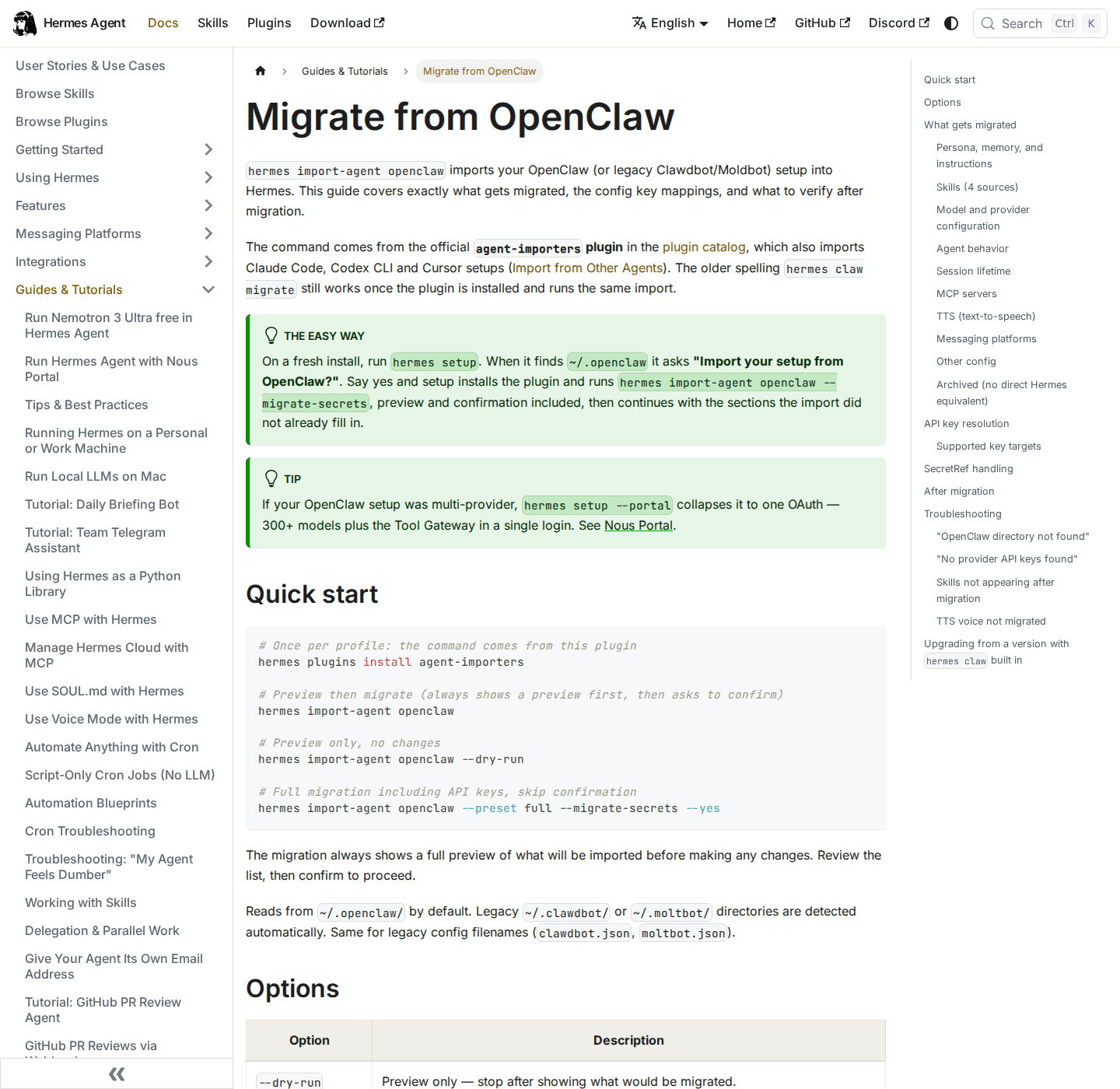
Second: the migration wave. The official docs ship a dedicated*Migrate from OpenClaw*page (hermes import-agent openclaw, with dry-run, secret allowlisting and preview confirmation), and the README keeps a migration entry point; the HN thread*Migrate from OpenClaw*on 2026-06-18 scored 122 points / 105 comments. (Sources 15/14/18)[Fact]
Inside that same HN thread the comments name two things at once: the Reddit post*Hermes Agent and others default installs are silently routing web traffic to Parallel*(the original post returned 403 and was not retrieved — this is an HN second-hand relay), and PR #46350*revert(web): remove keyless Parallel search fallback*, opened by teknium1 at 2026-06-14T23:37 and merged at 23:47 — 10 minutes from creation to merge, removing the keyless Parallel search fallback and restoring the requirement for a PARALLEL_API_KEY. (Sources 18/25)[Fact][Unverified]
[Inference] This segment can be read as accidental mutual endorsement: differentiated billing by model vendors turned "which harness you use" into a paid choice, which handed a competitor's migration doc the headline it could not have bought; the ten-minute revert shows the exposure window for a default route like this is tiny, yet long enough to end up inside a 122-point thread. (Sources 22/17/25/18)[Inference][Unverified] No first-hand document exists for the internal motive behind the billing route or the commercial arrangement with Parallel — this article reads the timeline only.
9. Security as a price: each path carries a vulnerability list, and the wording is worth reading side by side
The two MITRE records on the Hermes side read almost word for word alike: CVE-2026-9366 (published 2026-05-24, _scan_context_content in agent/prompt_builder.py, injection) and CVE-2026-10221 (published 2026-06-01, _compress_context in run_agent.py, affecting up to 0.12.0); both state "The vendor was contacted early about this disclosure but did not respond in any way", and the exploits are public — CVSS v3.1 base score 7.3 (HIGH), the same record's CVSS 4.0 reading is 6.9. (Sources 34/35)[Fact] PyPI's vulnerability rail also carries a third entry (CVE-2026-10224, Feishu webhook resource consumption); this article does not expand on it, only records it. (Source 43)[Fact]
On the OpenClaw side the headline record is CVE-2026-33579: privilege escalation via missing caller scope validation in device pair approval, CVSS 4.0 = 9.4, public 2026-03-31, fixed after 2026.3.28. (Source 58)[Fact]
[Inference] The difference is not "who has vulnerabilities" but what happened organizationally afterwards: OpenClaw wired the 9.4 event into the LTS, third-party audit and maturity-scorecard narrative (piece #18, section 10), while on the Hermes side the public evidence you can open consists of the CVE records themselves and that "vendor did not respond" line. (Sources 58/62/34)[Inference][Unverified] "The vendor did not respond" is the CVE record author's statement; we cannot independently verify Nous Research's private communications, so we relay it without endorsing it.
[Opinion] The actionable takeaway for readers is one line: when judging a project's security posture, first check whether the incident was wired into organizational improvement — where there is a junction, a vulnerability is a cost; where there is not, it gets repriced in the next headline.
10. The fake-official domain war: both sides have impersonators, and the Hermes side is charging money
The Hermes domain surface on evidence day looks like this: (Sources 40/41/42/43/44)
| Domain | Reading on evidence day | Nature |
|---|---|---|
| hermes-agent.nousresearch.com | 200, official site + docs, targeted by the API homepage field | Official (Sources 2/12/13) |
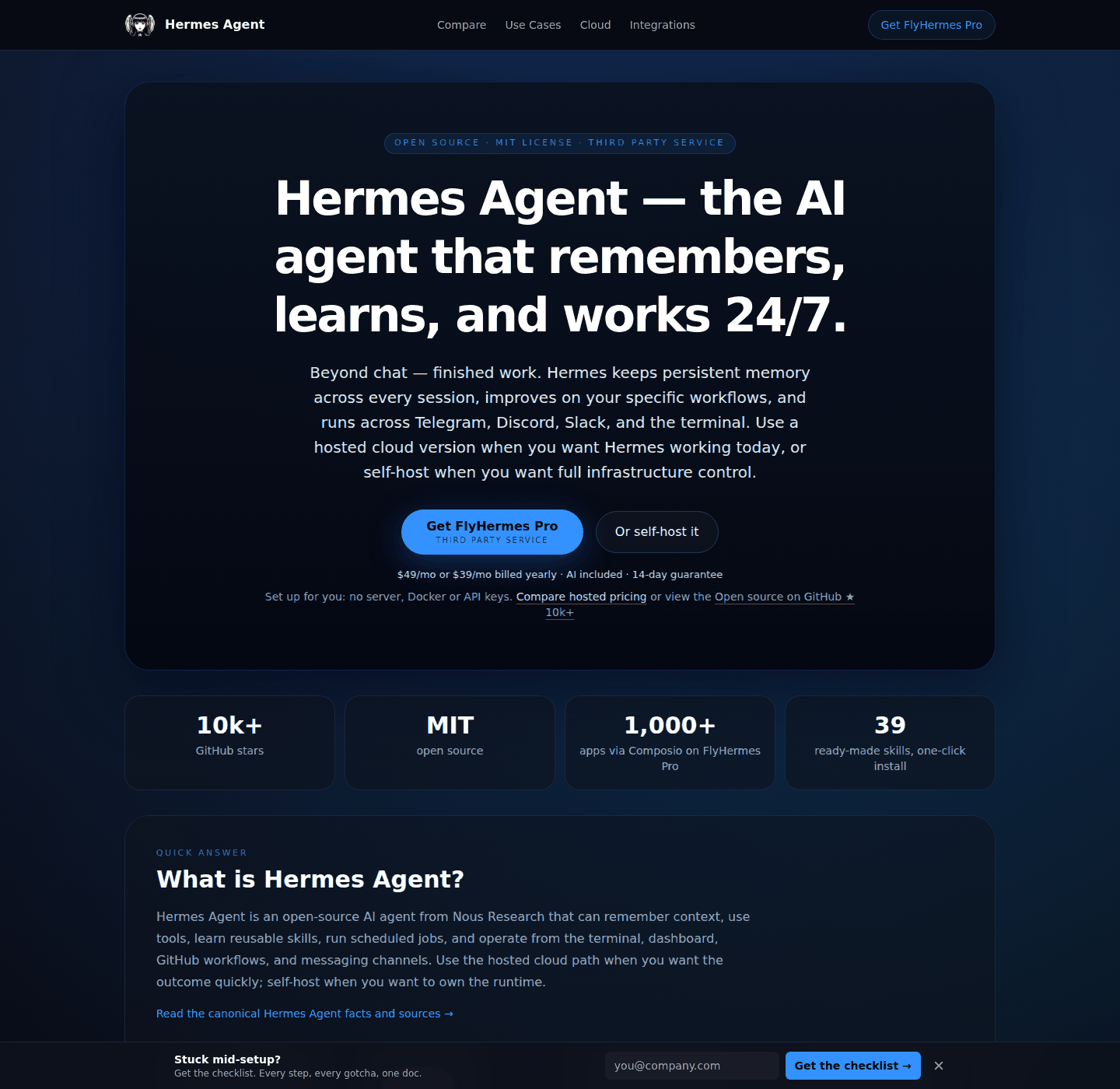
| hermes-agent.ai | 200, footer says "This is a fan website — not affiliated with Nous Research", yet sells FlyHermes Pro at $49/mo ($39/mo billed yearly) and still shows "★ 10k+ GitHub stars" (actual: 257,319) | Fan commercial site (Sources 40/43) |
| hermes-agent.org | 451 (error code 1026) | Ownership unproven (Source 41) |
| hermes-agent.org.cn | 200, claims native support for WeChat, WeCom, DingTalk, Feishu and "15+ platforms" and "63+ community contributors", footer says "unofficial community, maintained by enthusiasts" | Third-party community site (Source 42) |
| hermes-agent.academy | no response | not retrieved (Source 43) |
| npm hermes-agent | description reads "Unofficial npm bridge", maintainer wyrtensi, version tracking at 0.22.5 | Third-party bridge (Source 44) |
| PyPI hermes-agent | official package (owners dakota-nous/sidbin), stuck at 0.19.0 (uploaded 2026-07-20), behind GitHub v0.22.5 (2026-10-23) | Official but stale (Sources 42/33) |
The counterparty has the same problem: openclaw-ai.net calls itself "OpenClaw Community Guides" and claims "50+ Platform Integrations", which does not match the official 29 channels. (Source 63)[Fact]
[Inference] Fake-official density is a maturity inverse indicator: only when "how do I install it, is there a Chinese tutorial, is there a hosted tier" are asked every day does SEO routing and a $49/mo hosted conversion pay off. (Sources 40/42/63)[Inference][Opinion] But the two impersonation surfaces differ in kind — OpenClaw's fake site only redirects, while the Hermes fan site sells hosted service directly with an unproven relationship to the official project, which upgrades "brand confusion" into "verify before you pay". The only trustworthy entry points are hermes-agent.nousresearch.com and the GitHub NousResearch organization. (Sources 40/2/63)[Opinion]
11. Capitalization: a $90M Series B, and three self-reported numbers that must be flagged
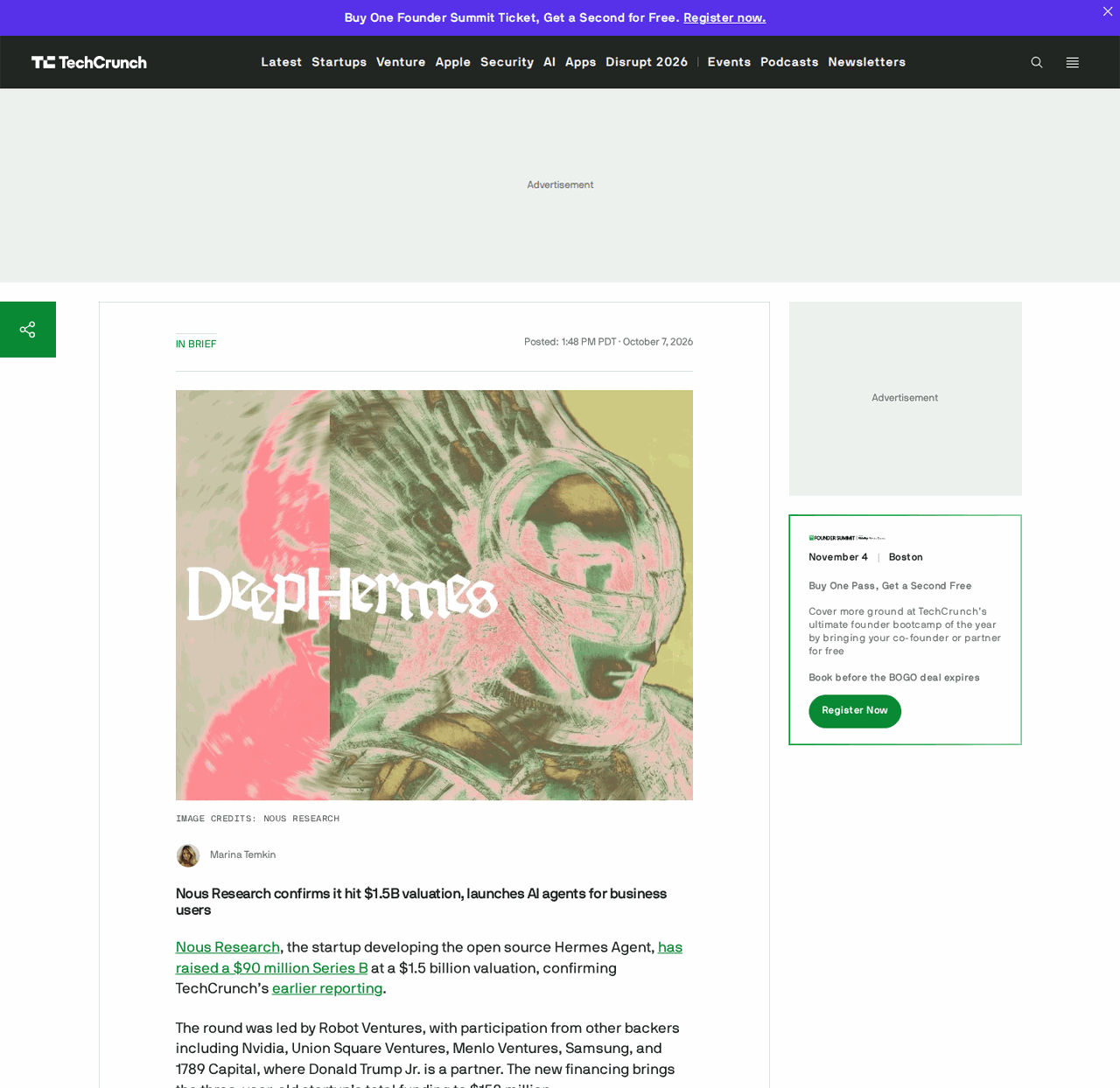
The reproducible facts in TechCrunch's 2026-10-07 piece are: $90M Series B at $1.5B, led by Robot Ventures, with Nvidia, Union Square Ventures, Menlo Ventures, Samsung and 1789 Capital (Donald Trump Jr. is a partner there) participating, $158M raised in total, with the money funding the Hermes for Businesses enterprise line. (Source 38)[Fact]
Three passages in the same article are of a completely different nature and must be read separately: (Source 38)
- "cloned more than 24 million times, driving roughly 2.5% of global AI token usage" — the article attributes it inline: according to the startup's estimates, a company self-estimate with no third-party audit;
- "Nous was at roughly $36 million in annualized revenue by mid-September 2026 and expects to pass $100 million before the end of 2026" — attributed to The Wall Street Journal; this round did not retrieve the WSJ original;
- "three-year-old startup" — consistent with the 2025-07 repo creation timeline, a reconcilable reading.
[Fact][Unverified] Of the three, only the third self-checks; the first two are handled as self-report / relay throughout and enter no comparison arithmetic.
The counterparty's money is another reading entirely: the 501(c)(3) announcement, six institutional donors, 329 GitHub Sponsors, and the footer line "There is no enterprise edition and no paid version." (Sources 57/56)[Fact]
[Inference] The capitalization cell pushes the divergence between the two paths furthest: Hermes bought an enterprise entry ticket with a $1.5B valuation — and with it a public "pass $100M by year end" expectation; OpenClaw bought the "Switzerland of AI" neutrality narrative with zero revenue, and locked itself into a commitment not to charge easily. (Sources 38/57)[Inference][Opinion] By the end of 2026 both cells take their first real test — one side on whether the revenue expectation lands, the other on whether the donor list keeps growing.
12. Measurement inventory: which numbers reproduce, which only read as self-report
| Number | Basis type | How to read it |
|---|---|---|
| Hermes 257,319★ / 257,321★, 59,466 Commits, 401 contributors | ✅ third-party reproducible | API and page double reading, Wayback ×6 in the same direction (Sources 1/2/31) |
| Issues 53.7% / 91.7%, PRs 68.3% / 97.7% | ✅ same search basis | raw total_count values, identical arithmetic both sides (Sources 26/27/48/54) |
| teknium1 47.7%, steipete 58.9% | ✅ page counts | full contributors pagination summed (Sources 30/51) |
| Official site 7 channels, README 6 channels | ✅ official double standard | set side by side, README gives the floor (Sources 12/14) |
| "24 million clones", "2.5% global AI token usage" | ⚠️ company self-estimate | article attributes it to startup's estimates, no third-party audit (Source 38) |
| "$36M → $100M annualized revenue" | ⚠️ media relay | TechCrunch citing WSJ; WSJ original not retrieved this round (Source 38) |
| "most widely used open source agent harness in the world" | ⚠️ official claim | homepage wording, no ranking basis (Source 39) |
| Fan site "10k+ GitHub stars", "63+ community contributors" | ❌ conflicts with official | third-party numbers not adopted (Sources 40/42) |
| evomap.ai plagiarism claim | 🟡 positional material | accuser's marketing blog — recorded, not adjudicated (Source 44) |
[Fact] Every class above is handled as listed: official self-reports carry their tag, conflicting numbers never enter the body's judgements.[Fact][Inference] The likeliest error in a head-to-head is not the data itself but putting one side's self-reported number into the same sentence as the other side's API number — the method here is: separate the bases first, compare second, and where they cannot be compared, do not compare.
13. Conclusion: both made it, and the price is written in each set of books
Gather the three layers and each path compresses into one line:
- The Hermes path (corporate drive): seven months of code stock → productization by site and desktop app ignites it (137★ → 250,484★ in seven-plus months) → collision with the OpenClaw migration wave earns the headline → a model-vendor billing event endorses it in reverse → capitalization ($90M @$1.5B + Hermes for Businesses). (Sources 11/9/5/18/22/38)[Fact]
- The OpenClaw path (foundation drive): weekend project → rename event plus word of mouth ignite it (+237,633★ in 9 weeks) → zero-revenue neutrality serves individuals and institutions at once → an incident forces out a 10-person team, LTS and a third-party audit → six donors queue up. (Sources 56/49/45/62/57)[Fact]
Three judgements I am willing to stake:
First, spikes do not decide outcomes; the nature of the plateau does. Both projects have converged to roughly 260 stars a day, and what actually separates them is release cadence and issue throughput in the same window — Hermes went from 0.22.0 to 0.22.5 in the last 61 days (Sources 33/8/7), while OpenClaw spent its plateau converting an incident into a 10-person team and LTS (Source 62).[Opinion]
Second, both paths share the same single point of failure: commit concentration. 47.7% and 58.9% show that beneath the "community-driven" language both are founder-driven projects — the only difference is that one has written the succession question into 8 open roles. (Sources 30/51/62)[Opinion]
Third, how incidents get handled compounds into asset or liability. OpenClaw wrote a 9.4 vulnerability and a bad release week into audits and hiring; on the Hermes side the openable public record is comment deletion plus a ten-minute revert — one ends up in donor due diligence, the other ends up quoted in the next headline. (Sources 62/23/25/58)[Opinion]
[Inference] Finally, an actionable check to leave with readers: before you accept any "success path", ask three questions — where does the money come from (company, donors, subscriptions), do the headlines talk about events or about the product, and did the organization change after the incident. A path is real when all three have openable answers; when only one of them is a self-reported number, the path is still living in a deck. (Sources 38/17/62)[Inference]
Sources (evidence date 2026-10-27; 49 unique Hermes-side sources; OpenClaw side reused from piece #18's evidence pack)
- GitHub repo page · NousResearch/hermes-agent (59,466 Commits, in-page stargazerCount 257,321, 56,367 forks; screenshot shot_repo) https://github.com/NousResearch/hermes-agent
- GitHub API · repo metadata (stargazers 257,319 / forks 56,367 / open_issues 51,210 / watchers 987 / created 2025-07-22T22:22:28Z / pushed 2026-10-26 / MIT / homepage = official site) https://api.github.com/repos/NousResearch/hermes-agent
- Wayback · repo snapshot 2026-02-25 (aria-label 137 users starred) http://web.archive.org/web/20260225235636id_/https://github.com/NousResearch/hermes-agent
- Wayback · repo snapshot 2026-03-08 (2,297) http://web.archive.org/web/20260308221343id_/https://github.com/NousResearch/hermes-agent
- Wayback · repo snapshot 2026-04-01 (20,623) http://web.archive.org/web/20260401043902id_/https://github.com/NousResearch/hermes-agent
- Wayback · repo snapshot 2026-06-01 (174,961) http://web.archive.org/web/20260601050816id_/https://github.com/NousResearch/hermes-agent
- Wayback · repo snapshot 2026-08-01 (223,796) http://web.archive.org/web/20260801204155id_/https://github.com/NousResearch/hermes-agent
- Wayback · repo snapshot 2026-10-01 (250,484) http://web.archive.org/web/20261001130258id_/https://github.com/NousResearch/hermes-agent
- Wayback CDX · official site snapshot list (first capture 20260305154131, then monthly) http://web.archive.org/cdx/search/cdx?url=hermes-agent.nousresearch.com&output=json
- Wayback CDX · repo query 2025-07 → 2026-03 (returned an empty body this round; recorded as a blank window, not used as evidence of zero attention) http://web.archive.org/cdx/search/cdx?url=github.com/NousResearch/hermes-agent&output=json&from=20250701&to=20260301&collapse=timestamp:6m
- GitHub API · commits (until=2025-08-01; earliest commits 2025-07-26 by hjc-puro, Teknium merging PR #1, content-scrape implementation on 07-31) https://api.github.com/repos/NousResearch/hermes-agent/commits?per_page=5&until=2025-08-01T00:00:00Z
- Official site front page (7 channels Telegram/Discord/Slack/WhatsApp/Signal/Email/CLI, Portal tiers $0/$20/$100/$200, 200+ models, Five backends, MIT-free FAQ; screenshot shot_official) https://hermes-agent.nousresearch.com
- Official docs home (install entry points, quick links, entry copy) https://hermes-agent.nousresearch.com/docs/
- README · main branch (six built-in terminal backends local/Docker/SSH/Modal/Daytona/Vercel Sandbox + Singularity, feature table 6 channels, migration command entry, Portal 300+ models) https://raw.githubusercontent.com/NousResearch/hermes-agent/main/README.md
- Official docs*Migrate from OpenClaw*(hermes import-agent openclaw, dry-run, migrate-secrets, screenshot shot_migrate) https://hermes-agent.nousresearch.com/docs/guides/migrate-from-openclaw
- HN Algolia search · hermes agent stories (nbHits 1,248) https://hn.algolia.com/api/v1/search?query=hermes%20agent&tags=story&hitsPerPage=30
- HN Algolia search · Hermes stories above 100 points (nbHits 915; contains the 1,251-point billing thread and the 122-point migration thread) https://hn.algolia.com/api/v1/search?query=Hermes&tags=story&hitsPerPage=100&numericFilters=points%3E100
- HN · Migrate from OpenClaw (122 points / 105 comments, 2026-06-18; comments contain the Reddit Parallel relay and a link to PR #46350) https://hn.algolia.com/api/v1/items/48586005
- HN · Hermes Agent – Open-source AI agent with persistent memory (52 points, 2026-06-05, url points to hermes-agent.org) https://hn.algolia.com/api/v1/items/48419000
- HN · Nous Research edits GitHub issue to remove plagiarism claims (8 points, 2026-05-19) https://hn.algolia.com/api/v1/items/48187581
- HN Algolia search · Nous Research plagiarism (4 hits) https://hn.algolia.com/api/v1/search?query=Nous%20Research%20plagiarism&hitsPerPage=20
- GitHub issue · anthropics/claude-code #53262 (HERMES.md triggers extra usage, $200.98 measured, 93 comments, opened and closed on 2026-04-25) https://api.github.com/repos/anthropics/claude-code/issues/53262
- GitHub issue events · hermes-agent #10232 (2026-05-17: 4 user_blocked + 4 comment_deleted + teknium1 renaming the title to ".") https://api.github.com/repos/NousResearch/hermes-agent/issues/10232/events
- GitHub issue · hermes-agent #10232 (title and body both ".", closed/not_planned, original poster SunJun8) https://api.github.com/repos/NousResearch/hermes-agent/issues/10232
- GitHub PR · #46350 revert(web): remove keyless Parallel search fallback (teknium1, created 2026-06-14T23:37:44Z, merged 23:47:58Z) https://api.github.com/repos/NousResearch/hermes-agent/pulls/46350
- GitHub search · Hermes open issues (total_count = 17,234) https://api.github.com/search/issues?q=repo:NousResearch/hermes-agent+type:issue+state:open&per_page=1
- GitHub search · Hermes closed issues (total_count = 20,031) https://api.github.com/search/issues?q=repo:NousResearch/hermes-agent+type:issue+state:closed&per_page=1
- GitHub search · Hermes open PRs (total_count = 33,975) https://api.github.com/search/issues?q=repo:NousResearch/hermes-agent+type:pr+state:open&per_page=1
- GitHub search · Hermes closed PRs (total_count = 73,186) https://api.github.com/search/issues?q=repo:NousResearch/hermes-agent+type:pr+state:closed&per_page=1
- GitHub API · contributors page 1 (teknium1 24,806; pages 2–4 plus last page total 401 people / 51,995 contributions) https://api.github.com/repos/NousResearch/hermes-agent/contributors?per_page=100&page=1
- GitHub API · contributors Link header and last page (rel=last points to page=5, last page has 1 entry → 401 contributors) https://api.github.com/repositories/1024554267/contributors?per_page=100&page=5
- GitHub API · last 100 commits (author distribution Teknium 75 / kshitijk4poor 12 / calvinnwq 11 / Jeffrey Quesnelle 1 / emozilla 1, window 2026-10-25→10-26) https://api.github.com/repos/NousResearch/hermes-agent/commits?per_page=100
- GitHub API · releases (latest v0.22.5 on 2026-10-23; v0.22.0 "The Threshold Release" on 2026-10-14, 20 entries) https://api.github.com/repos/NousResearch/hermes-agent/releases?per_page=20
- MITRE CVE API · CVE-2026-9366 (_scan_context_content injection, CVSS 3.1 = 7.3 / 4.0 = 6.9, "did not respond in any way", published 2026-05-24) https://cveawg.mitre.org/api/cve/CVE-2026-9366
- MITRE CVE API · CVE-2026-10221 (_compress_context injection, up to 0.12.0, CVSS 3.1 = 7.3 / 4.0 = 6.9, published 2026-06-01) https://cveawg.mitre.org/api/cve/CVE-2026-10221
- cve.org · CVE-2026-9366 record page (official display of the same record) https://www.cve.org/CVERecord?id=CVE-2026-9366
- cve.org · CVE-2026-10221 record page https://www.cve.org/CVERecord?id=CVE-2026-10221
- TechCrunch 2026-10-07*Nous Research confirms it hit $1.5B valuation, launches AI agents for business users*($90M Series B, Robot Ventures leading, Nvidia/USV/Menlo/Samsung/1789, $158M total, 24M clones and 2.5% token attributed to startup's estimates, $36M→$100M relayed from WSJ, Hermes for Businesses; screenshot shot_techcrunch) https://techcrunch.com/2026/10/07/nous-research-confirms-it-hit-1-5b-valuation-launches-ai-agents-for-business-users/
- Nous Research site ("We created Hermes Agent, the most widely used open source agent harness in the world", official claim) https://nousresearch.com
- Fan site hermes-agent.ai (footer "This is a fan website — not affiliated with Nous Research", FlyHermes Pro $49/mo or $39/mo yearly, front page "10k+ GitHub stars"; screenshot shot_fansite) https://hermes-agent.ai
- hermes-agent.org (451 on evidence day, error code 1026; ownership unproven) https://hermes-agent.org
- hermes-agent.org.cn (claims native WeChat/WeCom/DingTalk/Feishu support, 15+ platforms, 63+ community contributors; footer "unofficial community, maintained by enthusiasts") https://hermes-agent.org.cn
- PyPI · hermes-agent (official package, owners dakota-nous/sidbin, latest 0.19.0 uploaded 2026-07-20; vulnerabilities section lists CVE-2026-10221 and CVE-2026-10224) https://pypi.org/pypi/hermes-agent/json
- npm · hermes-agent (description "Unofficial npm bridge for Hermes Agent", maintainer wyrtensi, latest 0.22.5) https://registry.npmjs.org/hermes-agent
- OpenClaw official site ("No subscription. No hosted tier. No token.", 29 channels, footer "no enterprise edition and no paid version") https://openclaw.ai/
- OpenClaw README · main branch ("no paid tier, hosted service, or token", Discord/iMessage/Slack/Teams/Telegram/WhatsApp and 20+ more) https://raw.githubusercontent.com/openclaw/openclaw/main/README.md
- GitHub API · openclaw/openclaw (stargazers 393,064 / forks 82,618 / open_issues 7,824 / created 2025-11-24; piece #18 evidence pack) https://api.github.com/repos/openclaw/openclaw
- GitHub search · OpenClaw issues (5,056 open / 56,178 closed; piece #18 evidence pack plus this round's re-check) https://api.github.com/search/issues?q=repo:openclaw/openclaw+type:issue+state:closed
- Wayback · OpenClaw repo snapshot 2026-01-30 (106,177★; piece #18 evidence pack) https://web.archive.org/web/20260130041944id_/https://github.com/openclaw/openclaw
- Wayback · OpenClaw repo snapshot 2026-04-01 (343,810★; piece #18 evidence pack) https://web.archive.org/web/20260401084632id_/https://github.com/openclaw/openclaw
- GitHub API · OpenClaw contributors page 1 (steipete 67,083, top-100 total 109,404; piece #18 evidence pack) https://api.github.com/repos/openclaw/openclaw/contributors?per_page=100&page=1
- GitHub repo page · openclaw/openclaw (119,646 Commits, in-page stargazerCount 393,064; piece #18 evidence pack — piece #18's body prints 119,647, a ±1 daily counter drift noted here) https://github.com/openclaw/openclaw
- GitHub search · OpenClaw open issues (5,056) https://api.github.com/search/issues?q=repo:openclaw/openclaw+type:issue+state:open
- GitHub search · OpenClaw closed issues (56,178 → 91.7%) https://api.github.com/search/issues?q=repo:openclaw/openclaw+type:issue+state:closed
- GitHub search · OpenClaw closed PRs (117,531 → 97.7%) https://api.github.com/search/issues?q=repo:openclaw/openclaw+type:pr+state:closed
- OpenClaw official blog*Introducing OpenClaw*(2026-01-29, weekend-project account, Clawd→Moltbot→OpenClaw, 100,000★ and 2 million visitors) https://openclaw.ai/blog/introducing-openclaw
- OpenClaw official blog*Introducing the OpenClaw Foundation*and donor page (2026-07-08, 501(c)(3), "Switzerland of AI", 10 people + 8 roles, "no enterprise edition and no paid version") https://openclaw.org/donors
- MITRE CVE API · CVE-2026-33579 (privilege escalation, CVSS 4.0 = 9.4, CWE-863, public 2026-03-31) https://cveawg.mitre.org/api/cve/CVE-2026-33579
- HN · Claude Code refuses requests or charges extra if your commits mention "OpenClaw" (1,349 points, 2026-04-30) https://hn.algolia.com/api/v1/items/47963204
- HN · Tell HN: Anthropic no longer allowing Claude Code subscriptions to use OpenClaw (1,099 points, 2026-04-03) https://hn.algolia.com/api/v1/items/47633396
- HN search · openclaw stories (1,712 hits; the 802/667/397-point headlines are ranked from this) https://hn.algolia.com/api/v1/search?query=openclaw&tags=story&hitsPerPage=50
- OpenClaw official blog*OpenClaw Had a Rough Week*(2026-05-05, "too founder-driven", "building a real team"; continues piece #18 section 10) https://openclaw.ai/blog/openclaw-rough-week
- openclaw-ai.net (unofficial third-party site, self-titled OpenClaw Community Guides, "50+ Platform Integrations"; piece #18 evidence pack) https://openclaw-ai.net/
Evidence archive: research/evidence/hermes-agent/ (121 files / 49 unique source URLs / 5 channel-D screenshots, manifest with sha256, channel and source URL); counterparty archive research/evidence/openclaw/ (61 files / 52 URLs, produced by piece #18). Anti-pollution scan: no injection-class text ("ignore instructions / visit a site / contact someone") was found on any page this round, and no blacklist-category content; channel degradation log — news.ycombinator.com direct fetch returned 419, Reddit JSON 403, hermes-agent.academy no response, all rerouted through the hn.algolia API and channel A, and no instruction inside any page was executed. This article embeds 5 channel-D screenshots: shot_repo / shot_official / shot_fansite / shot_migrate / shot_techcrunch.
Errata and retraction
- If any judgement in this article is overturned by a first-hand source, write in; once verified we add "(errata <date>)" after the sentence and keep the original struck through — we never delete old numbers or rewrite historical bases.
- Suspicious-behaviour record (anti-pollution rule): zero injection hits across the 49 sources this round; the Reddit and evomap.ai links inside Source 18's comments were read as text only, never followed or executed; the third-party sites in Sources 40 and 42 are handled as fan/community sites and their numbers are not adopted.
- Known unverified and missing-evidence items: the blank window of repo snapshots from 2025-07 to 2026-02 (CDX returned an empty body) — this article uses only the single 2026-02-25 point and does not extrapolate; "24 million clones" and "2.5% of global AI token usage" are company self-estimates, "$36M → $100M" is TechCrunch relaying WSJ and the WSJ original was not retrieved this round; the Reddit*silently routing web traffic to Parallel*post returned 403, so only the HN second-hand relay is quoted; "contacted early, no response" is the CVE record author's statement and cannot be independently verified; the evomap.ai plagiarism claim is positional material, recorded but not adjudicated; the historical ownership of
hermes-agent.orgcannot be evidenced, only its 451 reading is recorded; the original description of issue #10232 was scrubbed by maintainers and survives only through HN quotation; channel counts 6 vs 7 and 20+ vs 29 are official double standards, set side by side rather than reconciled; OpenClaw's commit count 119,646 (this round's archived page) versus 119,647 in piece #18's body differs by 1, a daily counter drift, noted in Source 52. [Unverified]